Master Roofing
Keyword List
110 roofing search terms for SEO and Google Ads, organized by category and intent, with notes on how to use them. Copy them into your keyword research tools and check volumes and costs for your own market.
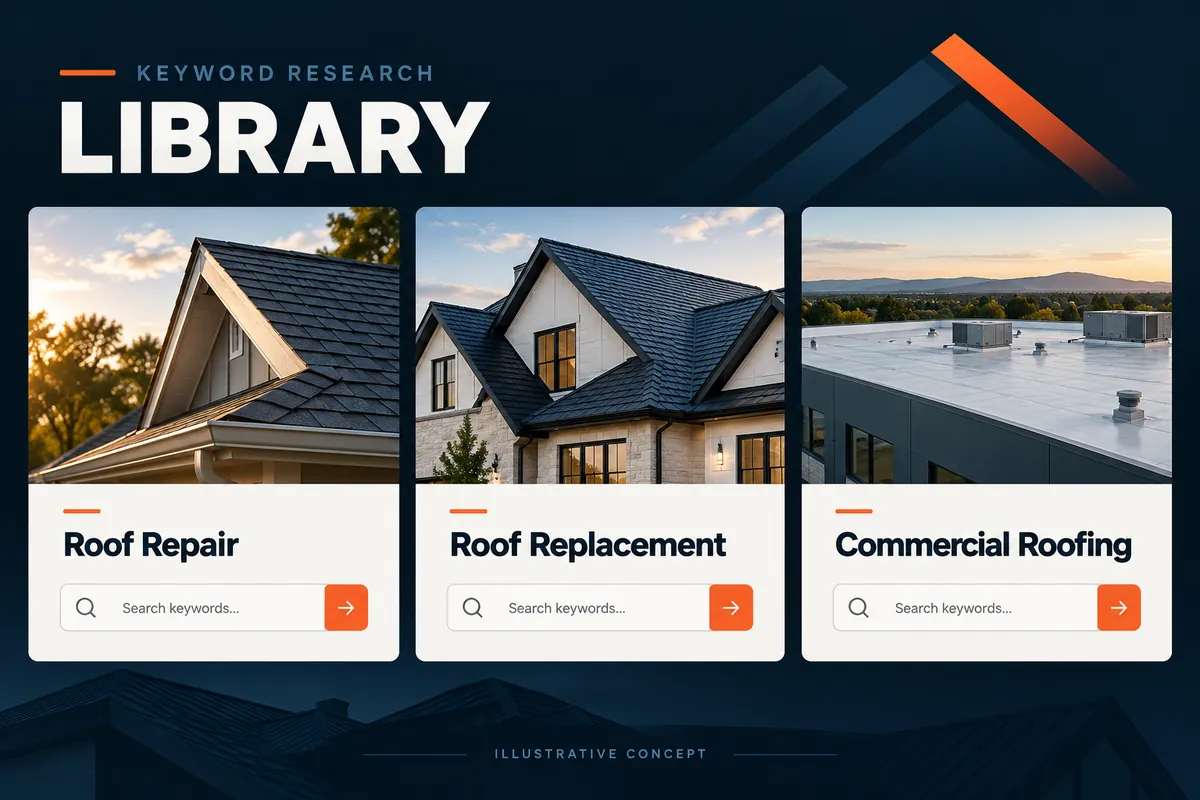
Why The Right Roofing Keywords Matter
Bidding on the wrong keywords is a common reason roofing PPC campaigns waste money. Three problems show up again and again:
Terms that are too broad
Terms like "roofing" or "roof" pull in DIYers, job seekers and people far outside your service area.
No negative keyword plan
Without negatives, ads show for searches such as "roofing nail gun" or "roofing jobs". The right negatives depend on your services, so we explain how to choose them below.
No match between query and page
People searching "roof replacement cost" and people searching "hail damage roof repair" want different pages. Matching intent is more important than collecting more keywords.
See how this feeds campaigns on PPC for roofers and pages on local SEO for roofers.
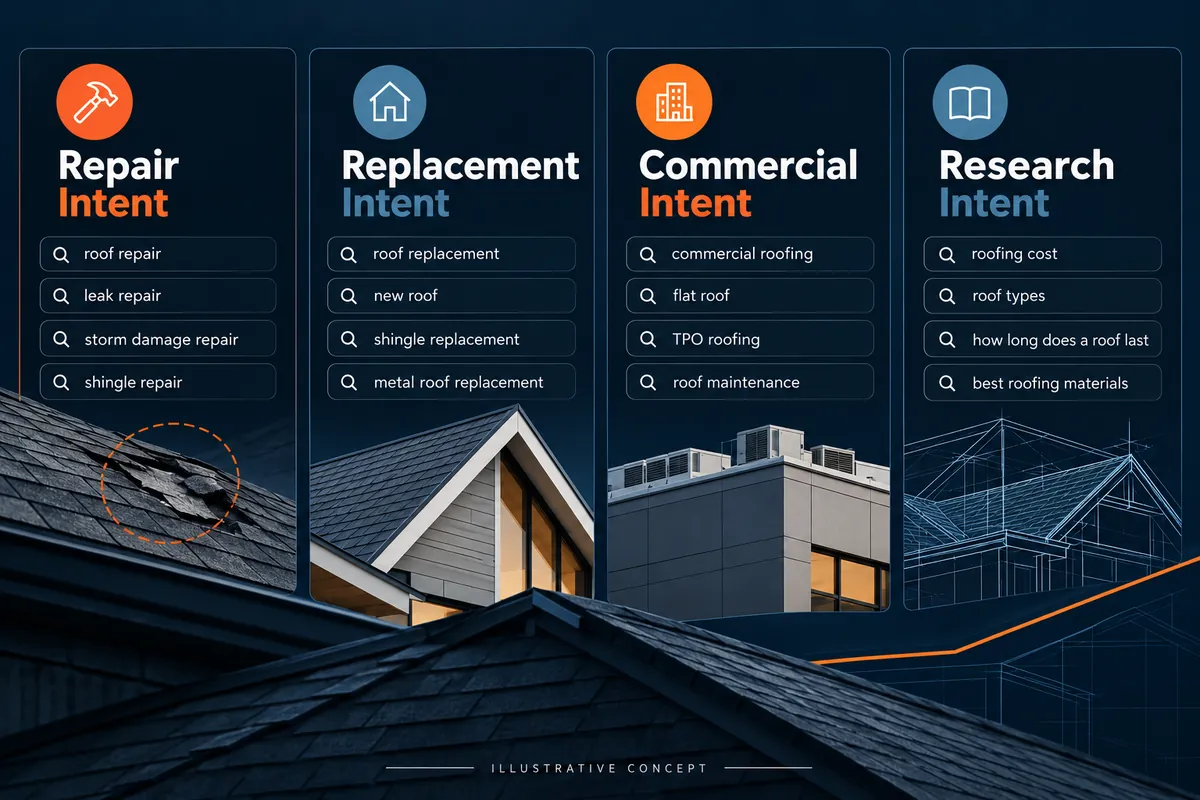
Every Keyword Is Tagged With An Intent
- Transactional: ready to buy. Usually the highest click cost and the most valuable searches.
- Informational: researching. Good for guides, video and early awareness.
- Local: a place or "near me" modifier. This is geography, not a buying stage, so a local search can also be transactional.
- Competitive: comparison and alternative searches. Handle with care and dedicated pages.
How Roofing Keyword Clusters Map To Pages And Campaigns
Intent (research, ready to buy, compare) and geography (a city or "near me") are separate dimensions. A "near me" search can be commercial, and a cost search can be early research. Group closely related queries into one cluster, give each cluster one main destination, and let campaigns use several terms.
| Cluster | Example queries | One main destination | Campaign use |
|---|---|---|---|
| Roof replacement cost | roof replacement cost, new roof cost, roof installation cost | One cost page for the service area | Search ads with a cost-focused landing page |
| Repair or replace? | roof replacement vs repair, should I repair or replace my roof | One decision guide | Mostly organic; ads only if you want repair leads |
| Hail and storm damage | hail damage roof, storm damage roof repair | One storm page, plus event pages when needed | Storm campaigns, see storm marketing |
| Local contractor | roofing company near me, roofing contractors plus your city | Service or service-area page | Local Service Ads and Maps work |
| Commercial roofing | commercial roofing contractor, TPO roof installation | Commercial service page | Targeted search and outreach |
Negative keywords depend on your business
Some terms are never useful, such as "rooftop bar" or "roof rack". Others depend on what you sell: a replacement-only company may exclude small repair terms, while a company that welcomes repairs or storm work should not. The same term can also be wanted in one campaign and excluded in another. Treat the negatives in this list as a starting point, then check your search-term report weekly.
110 Roofing Keywords
Organized by Category
Filter by category, search by keyword, or click any row to copy it instantly.
| Keyword | Category | Intent | Suggested Use |
|---|
Volumes and click costs change by market and season, so this list does not show them. Check Google Keyword Planner and your own search-term reports for your area.
Treat The List As A Starting Point, Not A Verdict
Search behavior differs by city, season and even neighborhood, so a list from any source needs checking against your own market. Four checks take an hour:
- Search each term yourself in a private window from your service area. Who appears, what kind of pages rank, and are there local pack results, ads or Local Service Ads?
- Use Google's keyword tools as estimates. Volume and cost figures are ranges, not exact numbers, and can be off for small local terms.
- Look at Search Console once your site has data, to see which queries already show your pages.
- Read the search terms report of any paid campaign weekly, and add what is irrelevant as negatives.
Where Each Type Of Search Should Land
A keyword is only useful if it points to the right page. One page per intent avoids pages competing with each other.
| Search type | Example intent | Best destination |
|---|---|---|
| Ready to hire, residential | Replacement, installation, contractor near me | A replacement service page with proof, process and a form. See residential reroofing marketing |
| Repair and emergency | Leak repair, emergency tarping | A repair page with a phone number prominent and fast-response messaging |
| Storm and hail | Hail damage inspection, storm inspection | An inspection-first storm page. See the storm playbook |
| Cost and comparison | Cost of a new roof, shingles vs metal | A guide or cost page that explains factors and invites an estimate |
| Commercial | Commercial flat roof repair, TPO roofing | A commercial page for facility and property managers. See commercial roofing marketing |
| Local modifiers | Roofer in a named town | A real area page only if you have local content. See service versus city pages |
| Research and planning | How long does a roof last, signs you need a roof | A helpful article that links to the money page |
How Keywords Behave In Paid Search
In Google Ads, exact and phrase match keep closer control, while broad match lets Google match related searches and relies heavily on good conversion data and negatives. Google has changed how match types behave several times, so check current documentation. Whatever you choose, negatives matter: terms such as jobs, salary, DIY, free quotes for tools or materials, and unrelated services drain budgets. The negative list in this resource is a starting point; add your own from the search terms report. See our PPC for roofers service and LSA versus Google Ads for how paid search is structured.
Keywords That Move With The Calendar
- ✓Storm and hail terms spike after weather events and fall quickly; have pages and campaigns ready before they do
- ✓Replacement searches often rise as weather warms in many regions, and repair searches follow leaks and storms
- ✓Financing and cost searches tend to come earlier in the decision process
- ✓Commercial terms follow budget cycles and emergencies rather than homeowner seasons
Plan around your own history. See the hail season checklist and what drives roofing lead cost.
Common Keyword Mistakes
- ✓Building one page for every keyword or city variation, which creates thin and competing pages
- ✓Targeting broad terms such as roofing alone, which attract job seekers and DIY searches
- ✓Ignoring negatives until the budget is spent
- ✓Choosing terms by volume without checking intent or your ability to serve the area
- ✓Copying a list without checking competitors and results in your market
- ✓Never revisiting the list after the first campaign
A Quarterly Keyword Review
Every quarter, export the search terms and Search Console queries, remove what does not convert, add the new phrases customers actually use, and update page titles and headings where a better match exists. Track booked inspections, not clicks, as the test of whether a keyword is worth keeping. See closed-loop attribution setup and how to tell if your marketing is working.
If You Can Only Start With A Handful Of Terms
A limited budget argues for focus. Pick one service you most want to sell, such as roof replacement, and choose a short set of exact and phrase terms with clear buying intent in the areas you can serve. Pair them with a dedicated page and a tracked number, add a firm negative list from day one, and review the search terms weekly. When those terms produce booked inspections at an acceptable cost, add repair, storm or commercial terms one group at a time. Starting narrow gives you data you can trust; starting wide gives you a bill. Our budget planning guide explains how to size that first test.
How to Actually Use
This Keyword List
Having keywords is step 1. Here's exactly where to deploy them across your marketing channels.
Google Search Ads
Load Transactional and Local keywords into exact and phrase match ad groups. Set budgets from your own targets and capacity. Review and add negatives before going live.
Local SEO & GBP Posts
Add geo-modified versions of Local keywords to your Google Business Profile description, services section, and weekly GBP posts. This tells customers which areas you serve.
Blog & Content SEO
Use informational keywords to decide which questions to answer. Group related queries into one useful page or FAQ instead of writing one post per keyword.
Website Service Pages
Build a service-area page only where you really serve, have local proof and there is distinct demand. Neighboring areas that do not meet that bar are better covered by one stronger page.
Facebook & Meta Ads
Use informational keyword themes to build Facebook interest audiences. Storm-related keywords pair perfectly with post-hail geo-fenced campaigns. Use the keyword language in your ad copy and creative headlines.
Negatives Need Context
Before you launch, review the negative keywords in this list against your services, then keep checking your search-term report.
Advanced Keyword
Strategy for Roofers
Lead with city plus service modifiers
Instead of "roof replacement", target "roof replacement Oakdale" and "roof replacement cost Oakdale" (Oakdale is a made-up example town; use your own). A geographic modifier narrows the search to your market and often matches buyer intent better.
Match keyword to landing page, always
Every keyword group should land on a page that exactly mirrors the intent. "Hail damage roof repair" should land on a storm-specific page, not your homepage. Matching the page to the query usually improves Quality Score and conversion.
Run search term reports weekly
Google will find new wasted terms you never anticipated. Check your Search Terms report every 7 days and add anything irrelevant to your negative list. This is a maintenance task, not a one-time setup.
Seasonal keyword adjustments
Storm-related searches rise after hail events. Pre-build storm-specific ad groups that are paused and ready to activate once approvals and capacity are confirmed.
Check Costs For Your Market
Click costs vary by city, season and competition, so a national average is not much use. Look up your own numbers in Google Keyword Planner, then judge each keyword by cost per booked inspection, not cost per click. A higher click cost can still be worthwhile if the searcher is ready to book and your sales process closes.
Download The Keyword List
Get the full list, including the negative keywords, as a CSV file you can open in Excel or Google Sheets. No sign-up needed.
Want help turning this into campaigns? See PPC for roofers or request a free audit.
Next Steps in Your
Marketing Toolkit
GBP Checklist for Roofers
30-point Google Business Profile audit with priorities for roofers.
Local SEO for Roofers
How we approach local search for roofing companies: profile, pages, reviews and citations.
Roofing PPC System
How we set up Google Ads for roofers to generate $8–$12 leads (not the $85/lead industry average).